

Bryn means hill, nant means stream, and coed means woods or trees. Spot one of those words on a Welsh house plaque and you have a first clue to the address. Pen-y-Bryn, for instance, describes the top of a hill. What it meant to the person who put it over the door can be a different story altogether.
One Welsh householder told researchers they had chosen the name Bryn Dedwydd because it had belonged to their grandmother’s house. The link between the two front doors was a happy childhood. You could have stood outside the newer house with a dictionary all day and missed that. The story appears in the Welsh Government’s study of place-name changes, section 7.14.
How to read the words on a Welsh house sign
Start with a whole name someone has recorded and translated. In her study of house and farm names in North Wales, Delia H. Pugh collected examples she encountered locally. Read these three aloud in English and each gives you a different place to stand.
| Welsh name | English sense | What to look for |
|---|---|---|
| Pen-y-Bryn | Top of the hill | Walk down the lane and look back. The rise can be easier to see from below. |
| Glan-y-môr | Seashore | Look for a coastal connection. In a family far inland, ask who remembers the sea. |
| Is Coed | Below the wood | Look uphill for trees. An older photograph might show woodland that has since gone. |
On another sign you might recognise afon (river), pont (bridge), rhyd (ford), or cefn (ridge). Glan can refer to a bank as well as a shore, so finding it at the start of a name is a reason to read the next word before you picture the sea. For more building blocks, try North Wales Housing’s glossary of local place and house names.
Why the name on the gate sometimes follows the family
Pugh met a man who delivered the post and also wrote poetry. Above his door, gold letters on glass announced Lletty’r Awen, a home for the muse. Elsewhere she recorded a man named Will Jones who was known locally by the name of his farm, Ael-y-Bryn. One man used a house name to tell visitors who he was. In the other case, neighbours used a place name to say which Will they meant. Read Delia H. Pugh’s account in the journal Names.
If an uncle wrote “Will Ael-y-Bryn” on the back of a photograph, keep that wording when you label the scan. Add what you know about the family surname on a separate line. Years later, someone looking for either name will be able to find him.
How to check a house name from an old Welsh address
- Copy the address line by line. Keep accents, gaps and hyphens as they appear. Include the town or village from the next line. A close-up of the house name looks lovely in a photo album, but the rest of the envelope may identify the right house.
- Look up the name and the location. In the List of Historic Place Names of Wales, use Search for a name. If all you know is the village, open Map and zoom in there. Compare the location with a second clue, perhaps a chapel or road named in the same letter.
- Ask the family how they used it. “What could you see from the gate?” is often easier to answer than “What did the name mean?” Save the speaker’s exact words alongside the source and date of the address.
A real example shows why the village alone can still leave you with two candidates. Gwernymynydd and Cadole Community Council lists two houses called Arfryn within its coverage, one on Glyndwr Road and one on Hafod Road. A road name in the corner of a Christmas envelope could settle a question that a beautiful photograph of the nameplate leaves open. See the community council’s house-name list. For an address that turns out to be a farm, follow our worked example of locating a Welsh farm on a tithe map.
Bring the name to a housewarming
Moving day is a lovely time to pass on what you found. Make a copy of the envelope or photograph and write one line underneath identifying the household, place and date. On the back, leave room for the new owners to add their own memory. A grandchild may one day be very glad someone bothered to write “the kitchen window was the one on the left.”
For a family who would enjoy something by the new front path, put the old house name in your note and choose their surname for the garden. If they’re Morgans, for example, the Morgan Welsh garden flag carries the family emblem on a tartan background. The smaller 12-by-18-inch size fits a modest planting bed. The flag comes without a pole, so check what stand they already have.
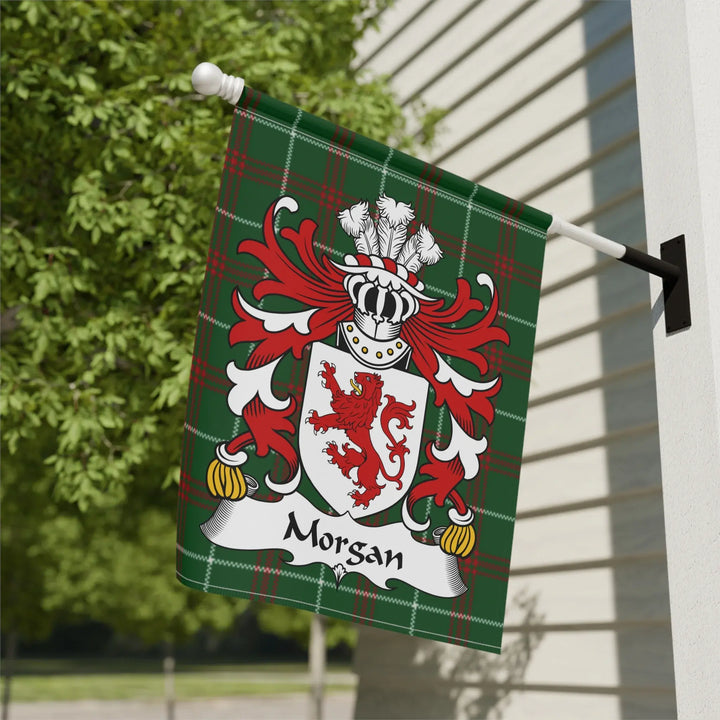
A short note can tie the two places together. “For the Morgans’ new garden. I’m enclosing the photograph of Pen-y-Bryn you loved. Here’s to the first summer in a garden of your own.” Choose the spelling your recipients use when you browse the Welsh surname garden flags.